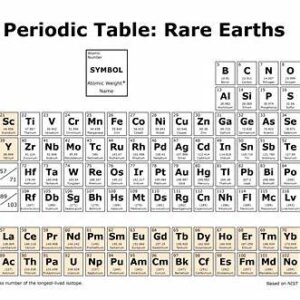
 Rare earths, or rare-earth elements (REEs), are a family of 17 chemically related metallic elements: scandium (Sc), yttrium (Y), and the 15 lanthanides — lanthanum (La), cerium (Ce), praseodymium (Pr), neodymium (Nd), promethium (Pm), samarium (Sm), europium (Eu), gadolinium (Gd), terbium (Tb), dysprosium (Dy), holmium (Ho), erbium (Er), thulium (Tm), ytterbium (Yb), and lutetium (Lu). Most are soft, silvery, reactive metals. They are chemically similar because they are usually trivalent (+3) and have closely related ionic sizes, but individual elements also have distinctive magnetic, optical, luminescent, catalytic, and electrochemical properties.
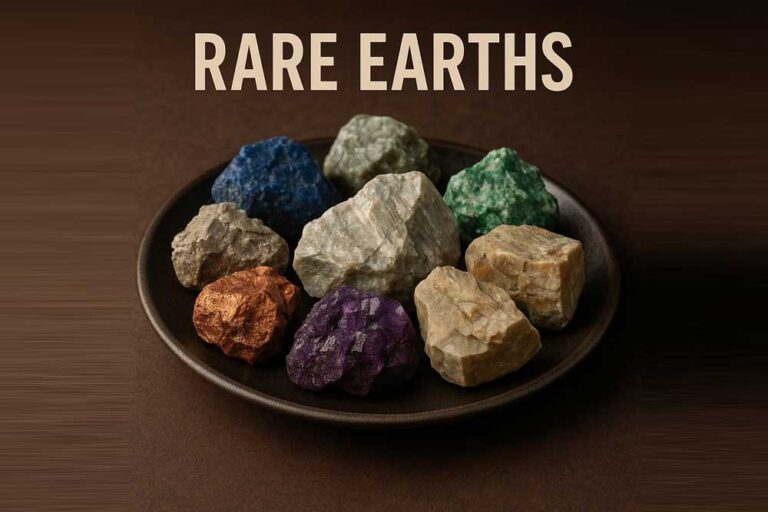
The name “rare earths” is historical and a bit misleading. They were originally identified in oxide-like materials once called “earths,” and they seemed uncommon when first discovered. In reality, many rare earths are not especially rare in the Earth’s crust; what is rare is finding them in highly concentrated, economically mineable deposits. They also usually occur mixed together in the same minerals, which makes separation and refining difficult. Important ore sources include bastnaesite, monazite, loparite, and ion-adsorption clays.
On the periodic table, most rare earths are in the detached lanthanide row below the main body, while scandium and yttrium sit in Group 3. For classification, they are often divided into light REEs (about La–Gd) and heavy REEs (Tb–Lu, with Y often grouped with the heavy side). In mining geology, scandium is sometimes discussed separately because it usually is not found in economic concentrations in the same geologic settings as the lanthanides and yttrium. Promethium is part of the lanthanide series, but it is radioactive and extremely scarce in nature.