Critical minerals are not a single chemical family. They are minerals, elements, substances, or materials considered critical because they are essential to an economy or national security and their supply chains are vulnerable to disruption. In the U.S. definition, the material must be essential, supply-risk exposed, and necessary for making products whose absence would have serious consequences. EU and IEA sources use the same basic idea: high strategic/economic importance plus high supply risk. Because “critical” is a policy-and-supply-chain label, the exact list can change by country and over time.
A useful plain-English definition is this: a critical mineral is a material modern society really needs, but cannot reliably or easily secure. That is why lithium, nickel, cobalt, graphite, copper, aluminum, silicon, and rare earth elements matter so much for batteries, power grids, electronics, defense systems, wind turbines, and EV motors.
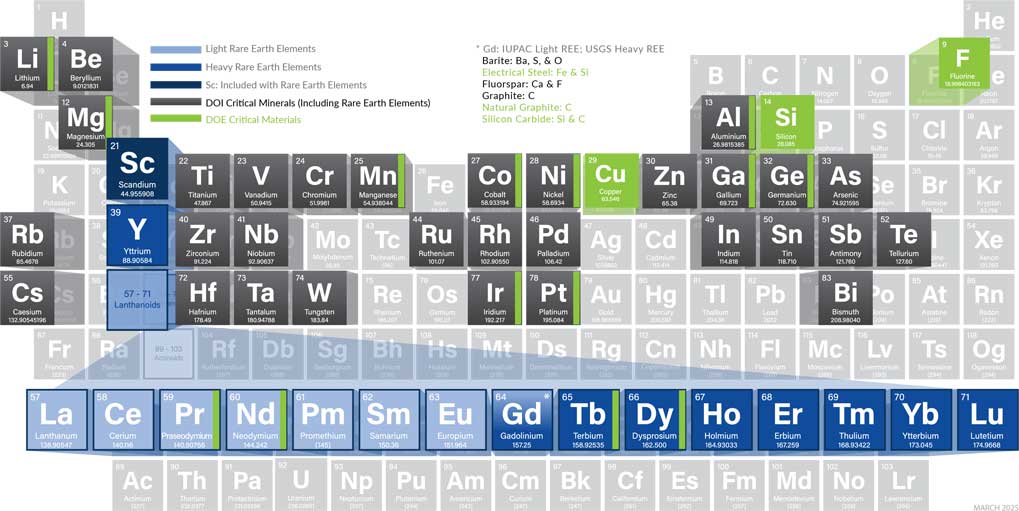
One important detail:
a periodic-table picture is only a partial shorthand for critical minerals, because some critical-mineral commodities are not single elements. USGS notes that materials such as graphite, barite, phosphate rock, potash, fluorspar, and metallurgical coal are also treated as critical commodities on policy lists.
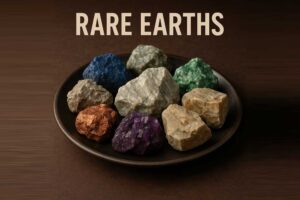
Rare earth elements (REEs) are a subset of the broader critical-minerals discussion, not the same thing. They are commonly treated as 17 elements: scandium, yttrium, and the 15 lanthanides. Despite the name, USGS describes rare earths as relatively abundant; the real challenge is finding them concentrated enough to mine and process economically.
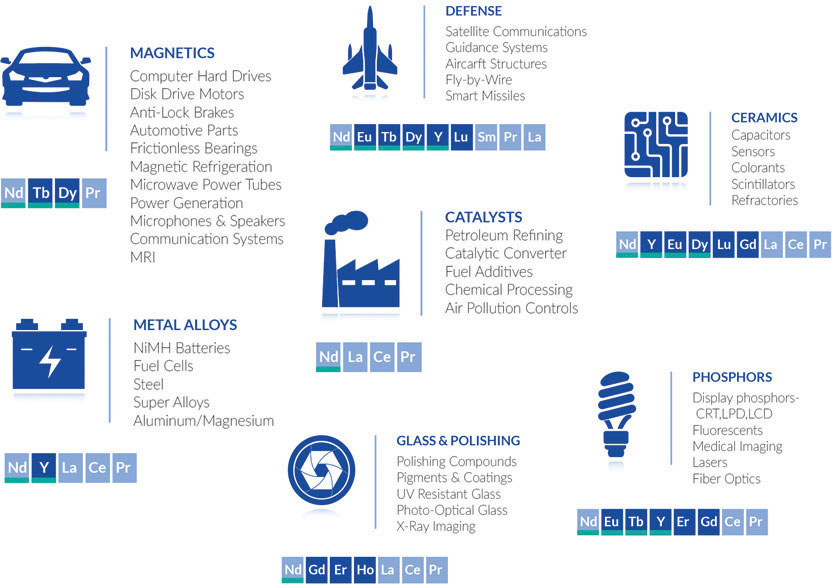
 A memorable example from USGS:
one wind-turbine magnet can require about 300 kilograms of neodymium.